
Step 1
Enter your campaign numbers
Paste ad spend and impressions from your ads manager. Fill any two fields — the calculator derives the third instantly.

CPM = (ad spend ÷ impressions) × 1,000. Work it out in seconds — then benchmark your numbers against TikTok, Meta, and YouTube averages.
Fill any two fields and we calculate the third. Typical CPMs: TikTok $3–$10, Meta $8–$14, YouTube $10–$20 (2025–2026 aggregated benchmarks).
Enter revenue and ad spend. Most DTC brands target a ROAS of 2x–4x depending on margin.
Enter ad spend and conversions. A good CPA stays below your break-even margin per order.
Your CPM
—
Fill any two fields and we calculate the third. Typical CPMs: TikTok $3–$10, Meta $8–$14, YouTube $10–$20 (2025–2026 aggregated benchmarks).
Enter revenue and ad spend. Most DTC brands target a ROAS of 2x–4x depending on margin.
Enter ad spend and conversions. A good CPA stays below your break-even margin per order.
Cheapest reach of the three major platforms.
Feed retargeting runs toward the top of the range.
Intent-based targeting raises the floor.
Three steps from raw campaign numbers to a decision.
Step 1
Paste ad spend and impressions from your ads manager. Fill any two fields — the calculator derives the third instantly.

Step 2
Compare your CPM with TikTok, Meta, and YouTube averages to see whether the auction, your audience, or your creative is the problem.

Step 3
High CPM with weak engagement usually means creative fatigue. Test more UGC variants instead of paying more for the same audience.
Typical ranges for paid social and video campaigns in the US market.
| Platform | Typical CPM | What moves it |
|---|---|---|
| TikTok | $3 – $10 | Broad targeting keeps CPM low; narrow interest stacks and small audiences push it up. |
| Facebook Feed | $8 – $14 | Retargeting and purchase-optimized campaigns run higher than prospecting. |
| Instagram Reels | $7 – $12 | Vertical video inventory is cheaper than static feed placements. |
| YouTube (skippable in-stream) | $10 – $20 | Longer view windows and intent-based targeting raise the floor. |

Sources
Updated July 2026. Ranges aggregated from public 2025–2026 benchmark reports (LocaliQ/WordStream paid social benchmarks, Varos aggregated advertiser data). Your actuals vary by geo, seasonality, and audience size.
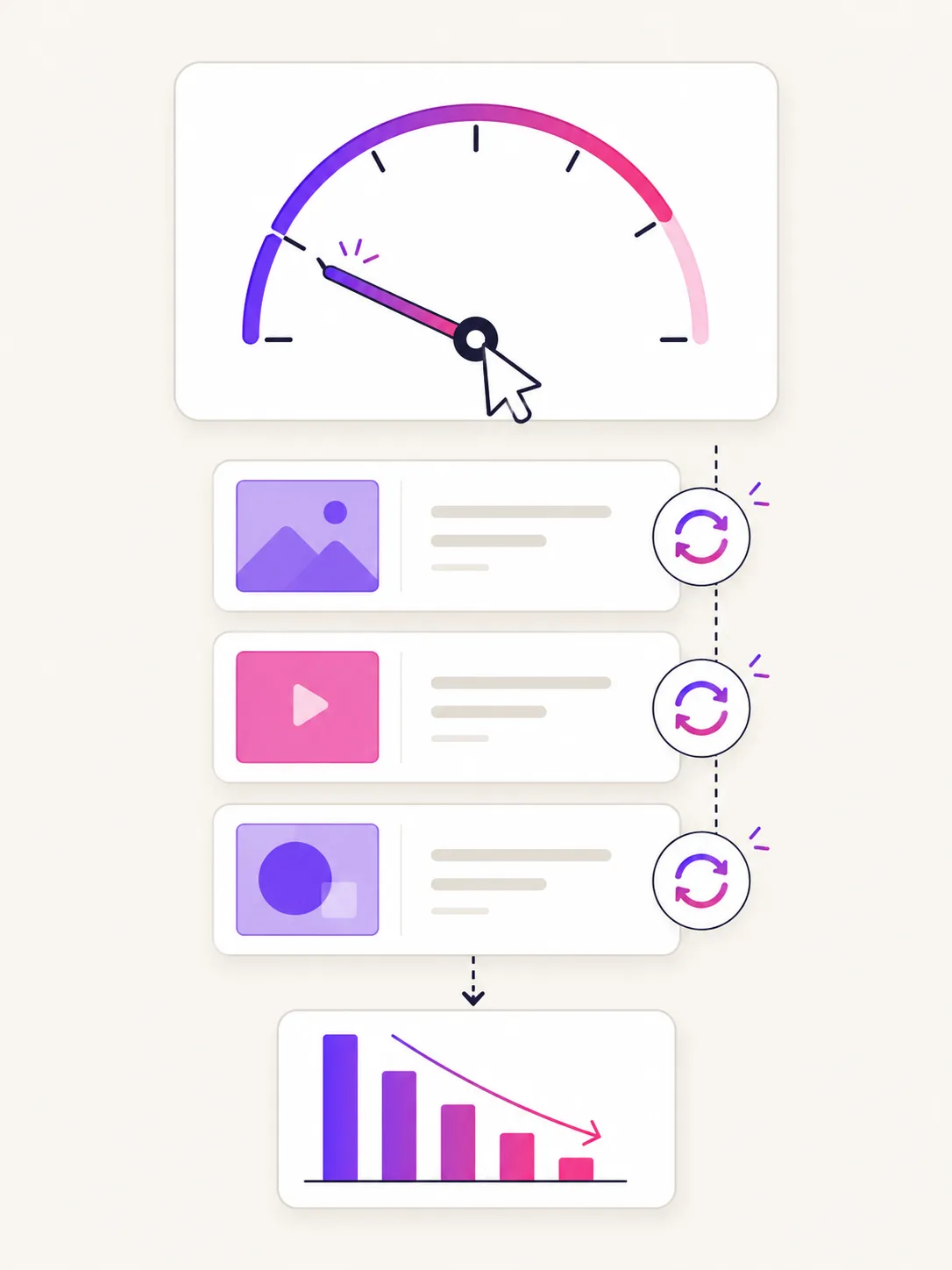
CPM (cost per mille) is what you pay for 1,000 impressions. It is set by the ad auction — competition for your audience, placement supply, and seasonality — which means you have limited direct control over it. What you do control is how much value you extract from each thousand impressions: that is a creative problem, not a bidding problem.
A high CPM is not automatically bad. Retargeting audiences and purchase-optimized campaigns pay more per impression but convert far better. The metric to watch is the pair: CPM together with CPA or ROAS. If CPM rises while ROAS holds, the auction got more expensive but your funnel still works. If CPM is stable while ROAS drops, your creative is fatiguing.
The fastest lever on effective CPM is refreshing creative. Platforms reward ads that people watch and engage with — TikTok and Meta both charge lower effective CPMs for creative with strong engagement signals. Rotating fresh UGC-style variants weekly is the standard playbook for keeping auction costs down without touching bids or budgets.
You cannot negotiate CPM with the platform — but you decide what each ad variant costs to make.
Sourcing, briefing, shipping product, and waiting days per variant makes systematic creative testing expensive.
Generate UGC-style variants from a product link in minutes — enough volume to actually test hooks against each other.
Fresh creative sustains engagement signals, and platforms reward that with cheaper impressions over time.

The testing loop
Ship, measure, replace
Generate 3–5 UGC variants
Different hooks on the same product, from one link.
Run them at equal budget
Let the auction tell you which hook holds attention.
Replace the losers weekly
Keep engagement signals fresh and CPM trending down.
CPM = (ad spend ÷ impressions) × 1,000. If you spent $500 for 40,000 impressions, your CPM is $12.50. This calculator also reverses the formula: enter any two of spend, impressions, and CPM to derive the third.
Typical US CPMs in 2026: $3–$10 on TikTok, $8–$14 on Facebook feed, $7–$12 on Instagram Reels, and $10–$20 on YouTube skippable in-stream (aggregated 2025–2026 benchmark data). It depends on platform and targeting — judge CPM together with ROAS or CPA, not in isolation.
CPM prices impressions (per 1,000 views), CPC prices clicks, and CPA prices conversions. CPM measures how expensive attention is; CPA measures how expensive results are. A campaign can have a high CPM and still a healthy CPA if the creative converts well.
ROAS = revenue attributed to ads ÷ ad spend. $4,000 revenue on $1,000 spend is a ROAS of 4x, or 400%. Most DTC brands target 2x–4x depending on gross margin; subscription products can run profitably lower.
The usual causes: audiences that are too narrow, too many overlapping campaigns bidding on the same users, seasonal auction spikes (Q4), or creative fatigue lowering your engagement signals. Fatigued creative is the most common and the cheapest to fix — refresh variants before touching budgets.
Broaden targeting so the auction has more supply, consolidate overlapping ad sets, and rotate fresh creative weekly. Platforms charge lower effective CPMs for ads with strong watch time and engagement — creative refresh is the lever advertisers control most directly.
No. All calculations run in your browser. Nothing you enter is sent to a server, stored, or shared.
Turn a product link into UGC-style video ads and test more hooks for less than one creator shoot.