A hook is the first 1–3 seconds of your ad — the part that decides the scroll. Describe your product, pick a platform, and get 8 hooks with the psychology behind each one — free, no signup.
Platform
Free · 5 generations per day · no signup
Example output
Problem
Still covering the same dark spots every single morning?
Names a felt, recurring pain in the first second.
Curiosity
I didn't believe a $20 serum could do this.
Opens an information gap the viewer needs closed.
Social proof
Everyone kept asking what I changed in my routine.
Borrows credibility from implied third-party reactions.
6 hook formulas that stop the scroll
Steal these structures — the generator above uses the same playbook.
Problem call-out
Template
"Still dealing with [specific problem] every day?"
Still covering the same dark spots every morning?
Your scalp shouldn't itch this much in winter.
Use when: The product fixes a pain the viewer feels often and can name instantly.
Curiosity gap
Template
"I didn't believe [claim] until I tried this."
I didn't believe a $20 serum could do this.
Nobody tells you this about retinol.
Use when: The product has a surprising mechanism or a result that sounds too good.
Social proof
Template
"Everyone kept asking me about [visible result]."
Everyone kept asking what I use on my skin.
This sold out three times last month — here's why.
Use when: The product has real traction — reviews, sell-outs, or word of mouth.
POV
Template
"POV: you finally found [outcome]."
POV: you finally found a moisturizer that doesn't pill under makeup.
POV: your morning routine is down to three minutes.
Use when: The outcome is a relatable everyday scene the viewer can picture themselves in.
Before / After
Template
"[Timeframe one] vs [timeframe two] — same lighting, no filter."
Week 1 vs week 6 — same lighting, no filter.
This was my skin in January.
Use when: The transformation is visually provable on camera.
Pattern break
Template
"Stop doing [common habit] — here's the fix."
Stop using toner like this.
You're applying SPF wrong — here's the fix.
Use when: The category is full of common mistakes. Highest risk, highest attention — test carefully.
1
Your hook sets your CPM
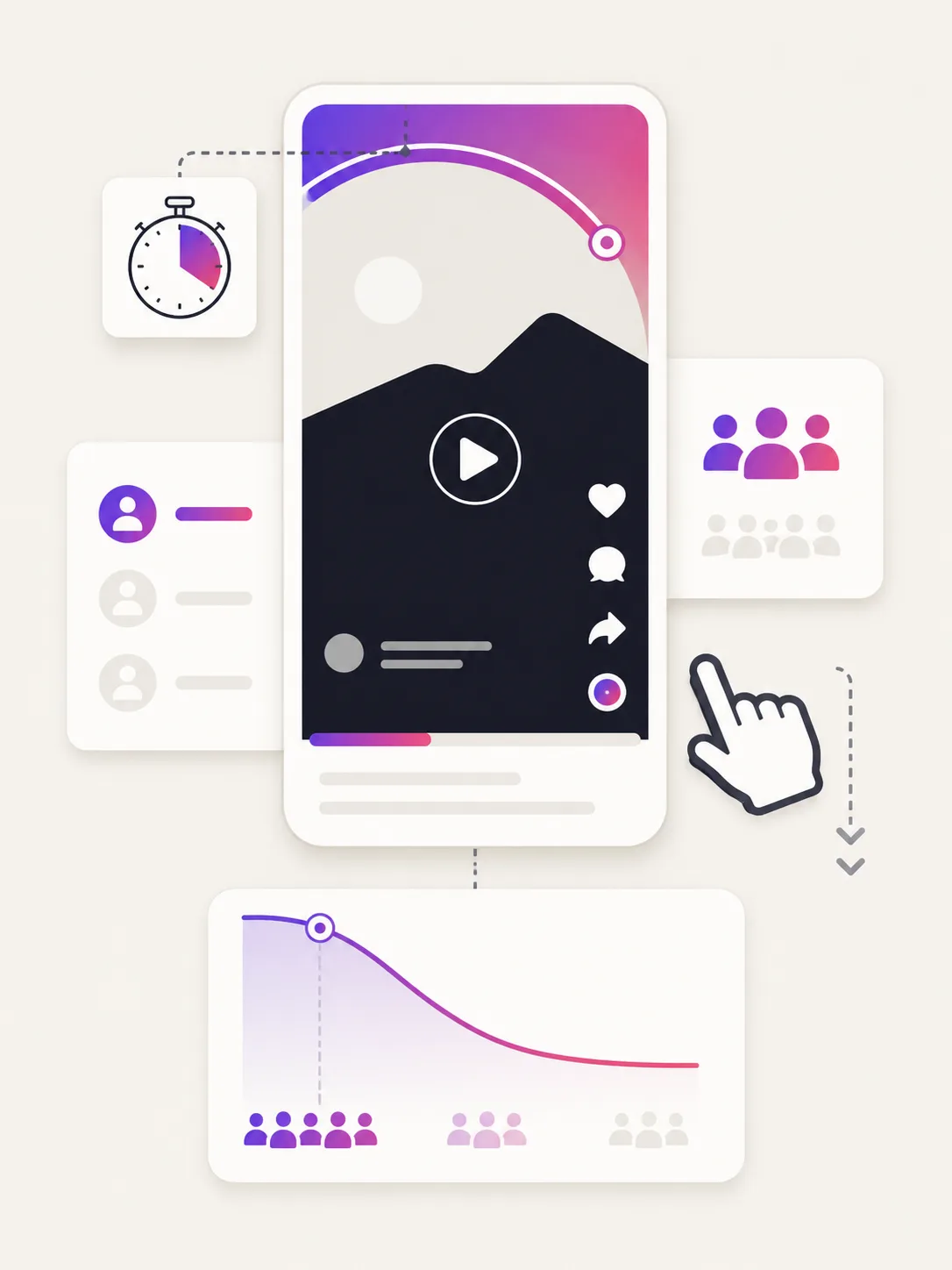
A hook is the first one to three seconds of a short-form ad — the part that decides whether the viewer keeps watching or scrolls. Platforms measure that decision: watch time and early retention feed directly into how cheaply your ad is delivered. A stronger hook doesn't just lift click-through; it lowers your effective CPM, because the auction rewards ads people actually watch.
2
There is no universally best hook
There is no universally best hook — only the best hook for one product, one audience, and one platform. TikTok rewards blunt, first-person openings; Reels tolerates slightly more polish; Meta feed needs the value proposition to survive with sound off. That's why the generator asks for a platform before it writes.
3
Volume beats perfection
The practical workflow is volume, not perfection: generate a batch, shortlist the three or four that fit your product's real proof points, and put a video variant behind each one. Let the auction pick the winner — hook testing is the cheapest experiment in paid social, and the winning hook usually isn't the one you'd have bet on.
Updated July 2026. Hook-length and retention guidance reflects TikTok Creative Center and Meta creative best-practice documentation on early attention and delivery quality.
How to use the hook generator
From product description to tested hooks in three steps.
Step 1
Describe your product
One or two sentences with the outcome, audience, and any proof points. Pick your platform — tone changes with placement.
Step 2
Shortlist the hooks worth testing
Each hook comes with the psychological trigger it uses. Pick three or four that match claims you can actually back up.
Step 3
Turn them into UGC videos
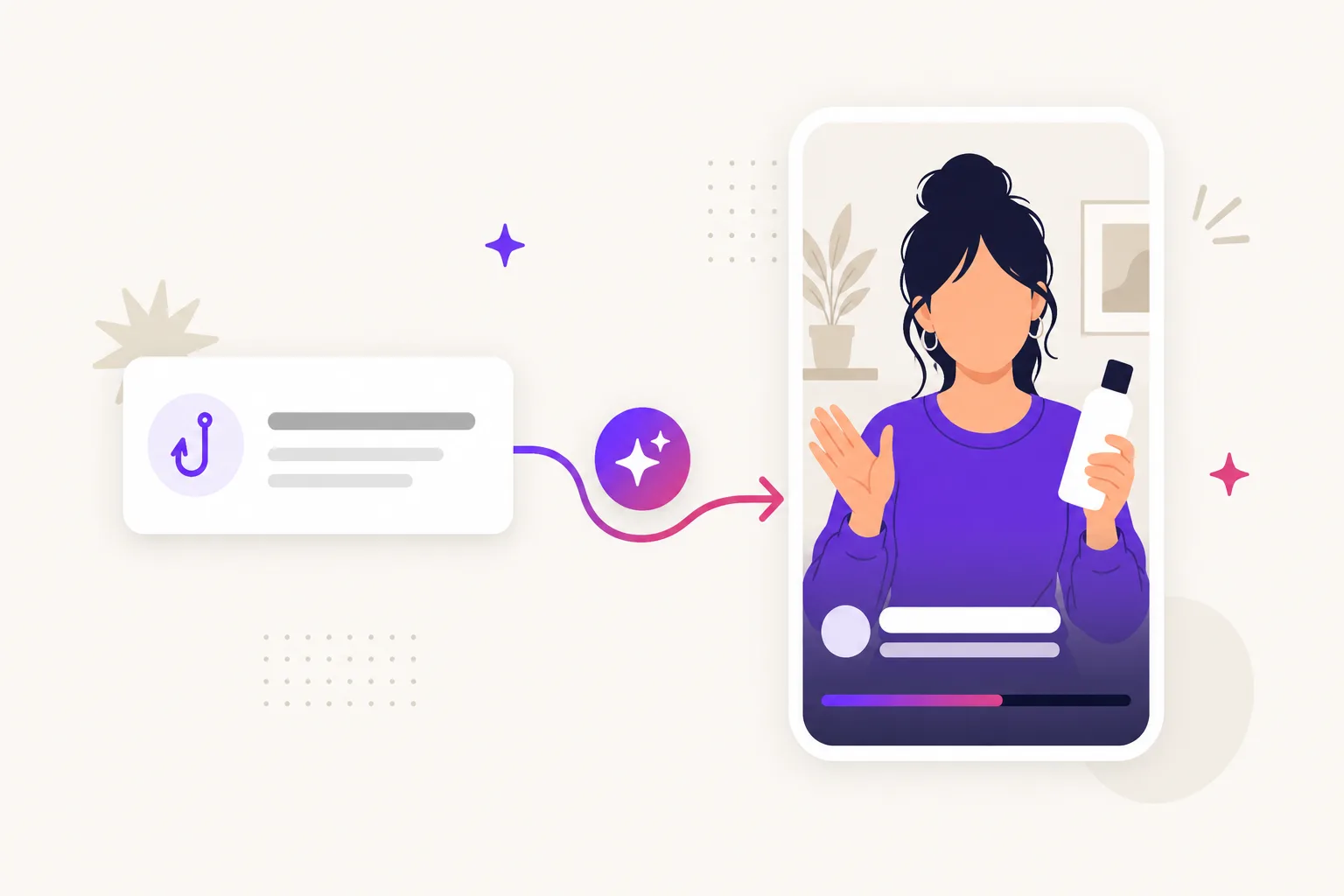
A hook only proves itself in a video. Generate a UGC-style variant per hook and let the auction pick the winner.
Hooks are free. Testing them is where the money goes.
A hook only proves itself as a video against a real audience — and that used to be the expensive part.
1
Creator route: $60–$150 per hook tested
Each hook needs its own video. With creators, an eight-hook test costs more than most small ad budgets.
2
AI UGC route: about $5 per hook tested
Generate a UGC-style variant for every shortlisted hook from one product link — a full test costs less than one creator video.
3
The winner compounds
A winning hook lifts early retention, which lowers effective CPM across the whole campaign — the cheapest lever in paid social.
The testing loop
Generate, shortlist, verify
1
Generate 8 hooks
Free, above — grounded in your product's actual claims.
2
Make a variant per hook
Same product, same script body, different first 3 seconds.
3
Keep the winner
Equal budget per variant; the auction does the judging.
A UGC hook is the opening one to three seconds of a creator-style video ad — the line or visual that stops the scroll. It decides early retention, which platforms use to price your delivery, so the hook affects both CTR and effective CPM.
How long should a TikTok hook be?
One spoken sentence — roughly 8 to 14 words, under 3 seconds. If the value of watching isn't clear by second three, most viewers are gone. This generator caps every hook at 14 words for that reason.
What are examples of viral TikTok hooks?
Common structures: problem call-outs ("Still dealing with X?"), curiosity gaps ("I didn't believe this until I tried it"), POV framing ("POV: you finally found…"), before-afters ("Week 1 vs week 6"), and pattern breaks ("Stop doing X"). The formula library above has templates and examples for all six.
How many hooks should I test per product?
Three to four per round is the practical sweet spot: enough variety to learn which angle resonates, small enough that each variant gets meaningful budget. Generate a batch, shortlist, and put equal spend behind each.
Is the hook generator really free?
Yes — 5 generations per day, 8 hooks each, no signup and no credit card. The limit resets at midnight UTC. Turning hooks into full scripts, storyboards, and videos is what the UGCfy product does beyond this tool.
What's the difference between a hook and an opening line?
The hook is the whole first-three-seconds experience: the spoken line, the on-screen text, and the first visual. This tool writes the spoken line — pair it with a matching visual (show the problem, the result, or the product in hand) for full effect.
Does this tool store my product descriptions?
Descriptions are sent to our AI provider to generate hooks and are not published or used to train models. Anonymous rate-limiting stores only a salted hash of your IP, never the text you enter.
Found your hooks? Now put videos behind them.
Turn a product link into UGC-style video ads and test every hook for less than one creator shoot.