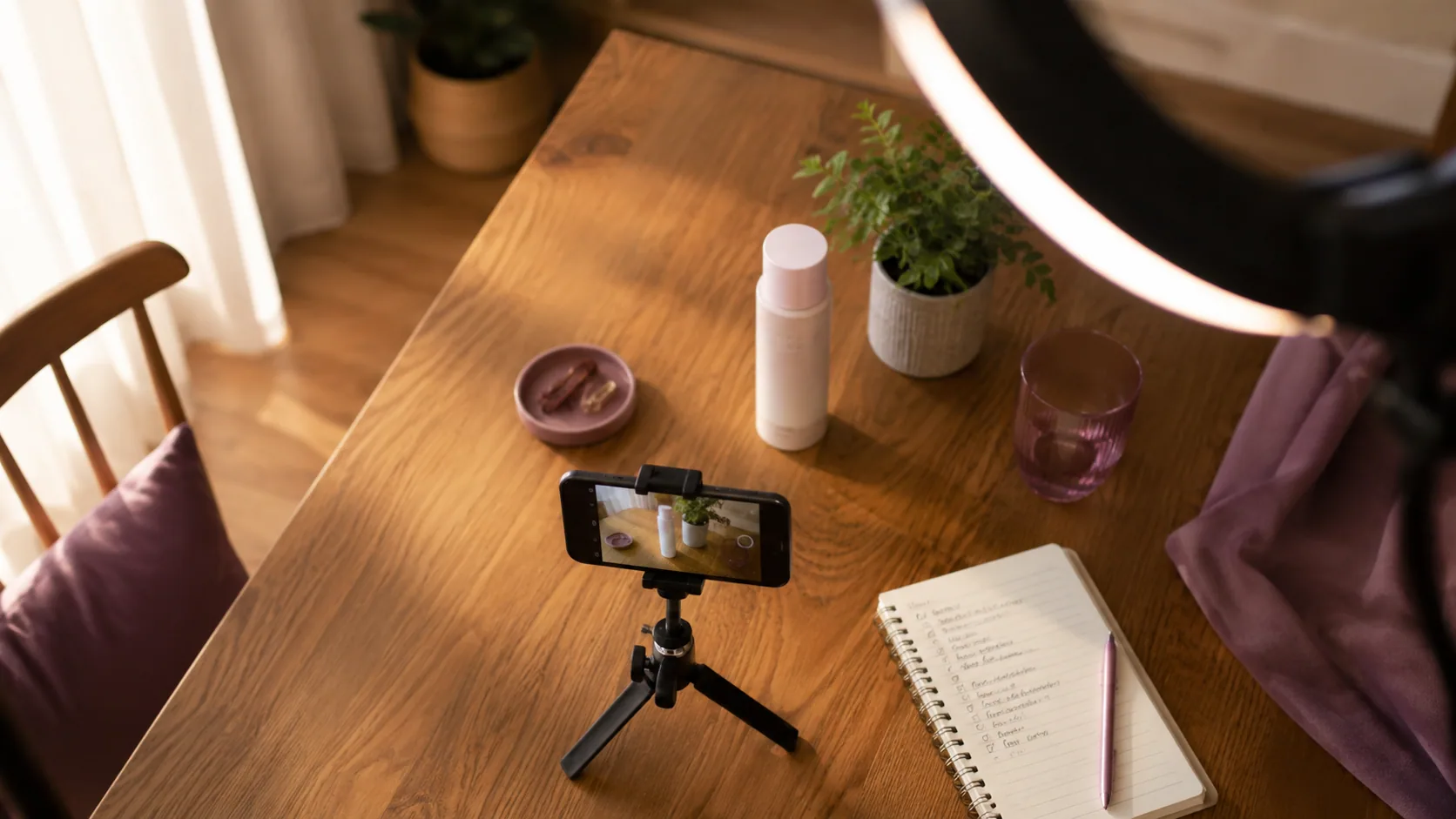
Instagram Reels Ads: Placement Rules, Creative Constraints, and Where Vertical Video Wins

Instagram Reels ads are vertical video ads delivered inside the full-screen Reels feed, where they appear between organic Reels and play automatically as the viewer scrolls. They behave like organic content: sound-on by default, thumb-driven, and framed by interface elements that cover parts of the screen. Meta publishes safe zone guidance specifically for Reels and Stories placements because of those overlays (Meta Business Help Center, fetched 20 August 2026).
Short answer: Treat Reels as a distinct creative surface, not a resize of your Feed asset. Build 9:16 video that survives sound-on playback, keep text and product hero moments out of the overlay-covered edges, and only isolate Reels into its own ad set when you have a Reels-specific creative you actually want to protect from broad delivery.
How Reels ads are actually delivered
The Reels feed is a single-item viewport. One video occupies the whole screen, the viewer swipes vertically to move on, and there is no adjacent content competing for attention. That changes the physics of the placement compared to Feed, where a viewer scans partial frames and half-visible captions while scrolling past several posts at once.
A few consequences follow from that delivery model:
- Attention is binary. The viewer is either watching your ad or has already swiped. There is no partial exposure the way there is in a scrolling Feed.
- Sound is part of the creative. Reels is an audio-first surface. A silent asset with burned-in captions still works, but it reads as an ad faster than something with voice, ambient room tone, or music.
- The exit gesture is cheap. A swipe costs nothing. Your first frame and first line of audio carry more weight here than in almost any other Meta placement.
Reels ads also carry the standard social affordances, like, comment, share, and save, which means the comment thread is visible to everyone who taps into it. If you run creator-style video, plan for comment moderation the way you would for an organic post.
Why safe zones drive your layout

The full-screen canvas is not fully usable. Interface elements sit on top of the video: the profile name and caption toward the bottom-left, the action column on the right, and the call-to-action button in the lower region. Meta documents text overlay and safe zone guidance for ads in Stories and Reels for this reason (Meta Business Help Center, fetched 20 August 2026). The exact pixel margins and current specifications live on the spec page rather than here, since they change: see our Meta ad specs breakdown for the dimensions, ratios, and length limits by placement.
What matters at the creative level is the reasoning, not the numbers:
- The lower third is borrowed space. Anything you place there, whether subtitles, price callouts, logos, or the product itself, risks sitting behind the caption block or CTA button.
- The top strip is also contested. Status bars and platform chrome sit there on many devices.
- The right edge is the action column. Avoid putting a face, a hand demonstrating a product, or key text against that side.
The practical fix is to compose for a central band. Put the subject and any burned-in text in the middle of the frame, and treat the top and bottom as bleed area for background, motion, or atmosphere. If you are captioning, place captions above the usual caption block rather than at the very bottom, which is where most editing templates default to.
One more thing worth checking before you launch: preview the ad in Ads Manager's Reels preview, not just the file in your player. A layout that looks balanced in a video editor often turns out to have a subtitle line sitting directly under the CTA button.
Reels versus Feed versus Stories
These three placements all accept vertical video, which is why teams collapse them into one asset. They reward different creative.
- Feed is a browsing surface. Viewers scan, often with sound off, and the caption is doing real work. Feed tolerates a slower open and rewards a strong opening frame plus readable on-screen text.
- Stories is a sequential, closed-loop surface. Viewers are moving through a set of posts from accounts they follow, and tapping forward is the default gesture. Stories creative tends to be short, direct, and tolerant of a hard-cut sales message.
- Reels is a discovery surface with sound on. The audience did not choose you, and the surrounding content is entertainment. Creative that opens like a piece of content, such as a person talking, a hand doing something, or a problem stated out loud, sits more naturally than a product beauty shot.
The most common mistake is exporting one 9:16 master and shipping it everywhere. It will technically render on all three, but the version that works in Stories is usually too blunt for Reels, and the version built for Reels often wastes its first two seconds when it runs in Feed. If you want to see how the same message gets rebuilt for different surfaces, it helps to review creative patterns and finished examples before you write the next brief.
Creative patterns that survive the Reels feed
The Reels surface is unforgiving toward anything that announces itself as advertising in the first beat. The patterns that hold up tend to share the same structure.
Open on a person or a hand, not a logo. Human motion in frame one reads as content. A product on a seamless background reads as an ad and triggers the swipe.
State the situation before the product. "I kept ruining my knives in the dishwasher" gets further than "introducing our new knife block." The product entering at second three or four feels earned.
Let the audio carry the hook. Since Reels plays with sound, a spoken first line does work that a text card cannot. Keep the burned-in caption as a redundancy layer for muted viewers, not the primary channel.
Cut on action, not on script beats. Reels viewers are conditioned to fast visual change. A static talking head for eight seconds is a swipe. Cutting to the product, the result, or a different angle every few seconds keeps the frame alive.
Show the outcome before you explain the mechanism. The result shot is the retention device. Feature explanations land better once the viewer has seen where it goes.
End with a reason to act, not just a button. The CTA button exists in the UI. Your closing line should give a reason to press it: a specific offer, a limitation, or a next step.
For a broader set of structures you can adapt to Instagram specifically, our Meta ad examples breakdown covers eight creative patterns worth rebuilding in 9:16. If you are writing creator-style scripts, the framing rules in our guide to UGC-style ads cover how to keep that voice honest.
Isolating Reels versus using Advantage placements
The recurring buying question is whether to let Meta distribute across all placements automatically or carve Reels out into its own ad set. Both are defensible. The decision usually comes down to whether you have a genuinely Reels-native asset and enough budget to feed a narrower ad set.
Let Advantage placements run when:
- Your budget is thin and splitting it would starve every ad set of delivery signal.
- You are in early prospecting and you do not yet know which surface your creative resonates on.
- You only have one vertical master, so isolating Reels would not change what actually ships.
Isolate Reels into its own ad set when:
- You have built a distinct Reels cut, sound-on, safe-zone-aware, and content-style in its open, and you do not want it competing against a Feed-optimised asset in the same auction pool.
- You need clean read on Reels performance for a creative decision, not just a blended placement report.
- Your product or audience skews toward the discovery behaviour Reels encourages, and you want to scale that deliberately.
- You are testing a creator-style angle that would look out of place in Feed.
A workable middle path: run Advantage placements for the broad prospecting ad set, and add a separate Reels-only ad set carrying your two or three strongest vertical concepts. You keep the efficiency of automatic distribution while still learning something specific about the surface. When a Reels asset earns its keep, promote it; when it stalls, replace it before the numbers sag rather than after. The diagnostics in our ad fatigue guide are relevant here.
A production workflow that keeps up with Reels volume

Reels burns creative. A discovery surface with a cheap exit gesture means you need more variants than a Feed-only programme, and the variants need to be different in substance, not just in colour grade.
A practical cadence looks like this:
- Fix the safe-zone template first. Build one project template with the central band marked and reuse it. This removes the most common re-export cause.
- Write hooks in batches. Produce five to ten opening lines per concept before you shoot or generate anything. The hook is the variable that moves most.
- Keep the body constant while testing hooks. Change one thing at a time so the read is interpretable.
- Retire on schedule. Set a refresh interval up front rather than waiting for a decline to force the decision.
This is where an AI production workflow helps. UGCfy AI starts from a product URL or a short brief and generates hooks, scripts, storyboards, AI actor scenes, captions, and ad-ready video outputs, with vertical 9:16 and square 1:1 formats and support for more than 20 output languages. That covers the volume problem for e-commerce brands, DTC teams, and agencies who need several Reels variants a week rather than one polished asset a month. It does not replace the judgment calls above: safe zone discipline, placement isolation, and hook selection are still yours.
One boundary worth stating plainly: if you use an AI actor, do not present that actor as a real customer. Keep testimonial-style claims to things you can substantiate, and disclose synthetic media where the platform or your market requires it.
Build your next Reels variant
Turn a product URL into vertical, safe-zone-aware creator-style video with hooks, scripts, and captions generated in one pass. Start with the example library to see the formats before you brief.
Frequently asked questions
What is an Instagram Reels ad?
It is a vertical video ad delivered inside the full-screen Reels feed, appearing between organic Reels and playing automatically with sound as the viewer scrolls. It carries the same social actions as an organic Reel, including likes, comments, shares, and saves.
Do I need a different asset for Reels than for Feed?
Technically no, practically yes. Both accept vertical video, but Feed is browsed with sound off and tolerates a slower open, while Reels is a sound-on discovery surface where the first spoken line and first frame decide whether the viewer swipes. A single 9:16 master will render everywhere but rarely performs equally well.
Where should I avoid placing text in a Reels ad?
Keep text away from the bottom region where the caption block and call-to-action button sit, the top strip where device and platform chrome appear, and the right edge where the action column lives. Meta publishes safe zone guidance for ads in Stories and Reels covering this; check the current specification page for exact margins, since they change.
Should I isolate Reels into its own ad set or use Advantage placements?
Use Advantage placements when your budget is limited, you are early in prospecting, or you only have one vertical master. Isolate Reels when you have built a genuinely Reels-native cut, need a clean performance read on that surface, or are testing a creator-style angle that would look out of place in Feed.
Where do I find the current Reels ad dimensions and file limits?
Meta's ads guide and the Business Help Center are the authoritative sources, and our Meta ad specs page consolidates the placement dimensions, ratios, and length limits. Those numbers decay, so verify against the first-party spec page before a launch rather than relying on any article's restated figures.
How many Reels creative variants should I run?
More than you would for a Feed-only programme, because a discovery surface with a cheap swipe gesture consumes creative faster. Batch several hooks per concept, hold the body constant while testing openings, and set a refresh interval in advance instead of waiting for performance to decline.